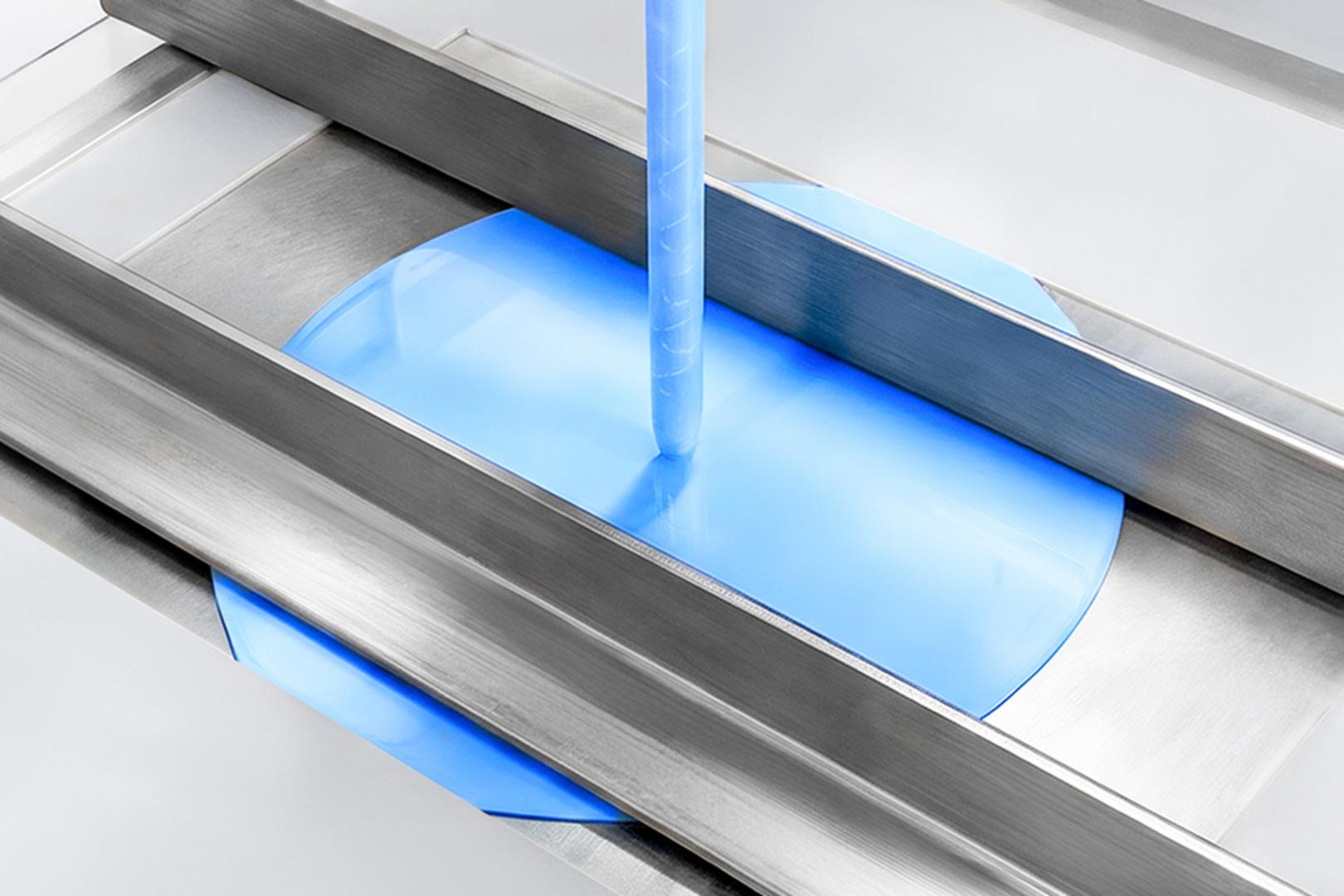
Conventional paste-like gap fillers with high viscosity quickly reach their limits when filling gaps measuring just a few millimetres. WEVOSIL 26029 FL, on the other hand, can be reliably applied, even in tight spaces.
Processing characteristics for efficient series production
With its precisely tailored rheological properties, Wevo’s new silicone gap filler can be applied as a bead and compressed into place using low pressure. If no free areas need to be connected, gaps can also be filled by injection – the product then remains in the gap without flowing out, owing to its high sag resistance.
The silicone gap filler can be processed using standard dosing systems, such as those used for potting applications – with both piston and eccentric screw pumps. Extruders or barrel as well as drum extrusion stations, which are required for many highly-filled gap fillers, are not necessary.
The sedimentation-optimised formulation of WEVOSIL 26029 FL allows it to be stirred using simple mixing tools within a few minutes, even after prolonged storage. The choice of filler and the low viscosity also help to prevent abrasion in the dosing systems and the associated maintenance costs.
Material properties for weight-optimised assemblies
Following curing without any by-products or volume shrinkage, the silicone gap filler provides tackiness (long-lasting surface stickiness) and good mechanical properties. As a thermal interface material (TIM), WEVOSIL 26029 FL combines a thermal conductivity of 3 W/m·K with a density of just 2.22 g/cm³. Featuring a significantly lower density than many highly-filled gap fillers with comparable thermal conductivity, the new Wevo product also supports weight-optimised assembly designs.
Gap filler for batteries and humanoid robots
In addition to high-voltage batteries – such as those for electric vehicles or industrial environments – robotics is one of the potential areas of application for this material. In humanoid robots, for example, compact high-performance batteries or electronic components can be thermally bonded to the outer skin using the silicone gap filler, even in narrow areas with thin layers of 1 to 2 mm, to support rapid, uniform heat dissipation.