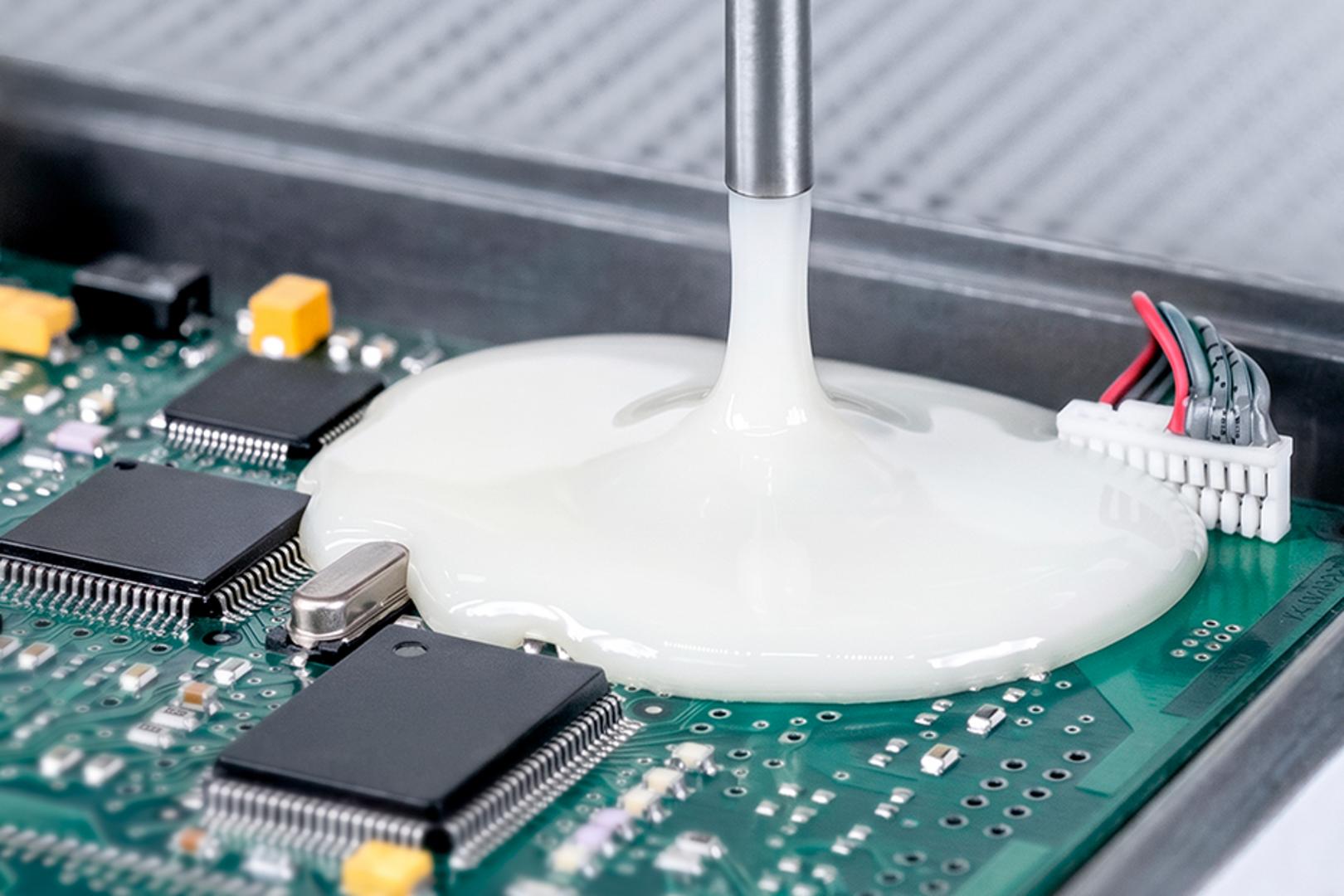
How potting-friendly design contributes to long-lasting electronics

Apart from the selection of suitable polyurethane potting compounds, component design and process parameters also play a key role in ensuring the manufacturing quality and long-term functionality of electronic assemblies. By taking potting requirements into account at an early stage, one can avoid subsequent design modifications and minimise the risk of operational failures – from printed circuit boards and sensors to applications in the energy and automotive sectors. The experts at Wevo provide practical knowledge on this subject with both face-to-face and online seminars.

The coordination of design and process management supports smooth electronics potting.

Potting-friendly design is an integral part of product development. It combines materials science, surface technology, component geometry and process management to form a holistic development approach.

Component design: the impact of design on the potting process

A common error in practice: the design is initially purely functional, without taking potting requirements into account. However, component design influences numerous parameters required for automated potting – such as venting, where the potting compound reliably displaces the air present within the component, thereby preventing air pockets. Cycle times are also affected by optimised flow paths resulting from the component design.

A further example: materials and surfaces – such as metals, plastics, paints or additives – react differently to potting compounds and affect their adhesion as well as flow properties. The development of stresses during subsequent operation, and thus the stability of the assembly over its service life, also depend on the substrates used.

Process parameters: prerequisites for smooth production

Even with a well-designed component, the potting process can reach its limits if process management is not properly coordinated. Typical potting defects – such as bubble formation, cracking or delamination – often arise not from the process itself, but from a lack of coordination between design and manufacturing.

In particular, any necessary pre-treatment steps, such as cleaning or surface activation, need to be taken into account. Component alignment, the potting sequence, layer thicknesses and curing conditions are also relevant factors and contribute to stable, reproducible electronics manufacturing when combined with the essential expertise.

Practical knowledge for developers and process managers

Wevo has been developing customised potting compounds for decades – and has first-hand experience of the challenges faced in development and manufacturing. In the company’s in-house seminars, experts share this knowledge directly with product developers, process engineers, manufacturing and production professionals as well as quality and plant engineers: in a practical, application-oriented manner and with specific solutions for common potting defects.

The next dates:

  • 6–7 July 2026, Esslingen am Neckar (Germany). Topic: Mastering the techniques of potting and encapsulation in electrical engineering and electronics (German-language). Book your place now
  • 9 June 2026, Novi (MI, USA). Topic: Polyurethanes – a versatile solution for demanding applications. Book your place now.

Please also take a look at our online seminars. Topic: Processing of polyurethane casting compounds. Sign up now and participate from anywhere.

Key insights on potting-friendly design:

  • Component design / venting: Optimised component geometries enable reliable displacement of air by the potting compound, ensuring void-free electronic assemblies.
  • Component design / cycle times: Constructively optimised flow paths support process speed in automated potting operations for efficient production.
  • Substrates and surfaces: Metals, plastics, paints and additives influence the adhesion, flow behaviour and stress development– and thus the long-term stability of assemblies.
  • Process parameters / pre-treatment: Cleaning and surface activation as upstream process steps support reproducible potting results.
  • Process parameters / potting control: Component alignment, potting sequence, layer thicknesses and curing conditions provide important control parameters for stable and reproducible electronics manufacturing.
  • Online seminar: “Processing of Polyurethane Casting Compounds” is offered as an online format for development and process engineers.

Key insights on potting-friendly design:

  • Component design / venting: Optimised component geometries enable reliable displacement of air by the potting compound, ensuring void-free electronic assemblies.
  • Component design / cycle times: Constructively optimised flow paths support process speed in automated potting operations for efficient production.
  • Substrates and surfaces: Metals, plastics, paints and additives influence the adhesion, flow behaviour and stress development– and thus the long-term stability of assemblies.
  • Process parameters / pre-treatment: Cleaning and surface activation as upstream process steps support reproducible potting results.
  • Process parameters / potting control: Component alignment, potting sequence, layer thicknesses and curing conditions provide important control parameters for stable and reproducible electronics manufacturing.
  • Online seminar: “Processing of Polyurethane Casting Compounds” is offered as an online format for development and process engineers.

Image source: © WEVO-CHEMIE GmbH

More News

News

Among other things, WEVOSIL 23130 offers high adhesive strength and excellent mechanical properties for secure sealing in the event of thermal…

Read more
Trade fairs

Free technical seminar on June 9, followed by exhibition on June 10–11, 2026.

Read more